Blanker

...

About This Blog

Memories of my travels between 1972 and 1982
Showing posts with label 1976. Show all posts

Thursday, 18 August 2011

August 18th: On The Road in Georgia and The Carolinas

On August 18th 1976 I was hitching north through Georgia and South Carolina.  I was spending a few weeks in the USA after flying in from Ecuador.

Two days earlier the plane had crossed the Caribbean islands and banked round Miami just missing a tropical storm.  There was a long wait for immigration and the man in customs gave me a good going over; I guess he thought a longhair with a beard coming from South America might produce something, but he did it with good humour.  I didn't feel like taking a bus downtown and, seeing on a map that the airport was to the north of the city, I just walked out of the airport and put out my thumb amidst the bright reds of the sunset.  Three lifts took me to Daytona for about 4 in the morning and I curled up for a rest.

The next day was hard going with very little progress.  I had a couple of lifts early on which took me to the Flagler Beach area, but then I got stuck.  I spent much of the day near a petrol station where I could get something to drink.  It was very hot and humid after the high, thin air of the Andes.  There were other hitchers too and that made things more difficult.   The cops were keeping an eye on me to make sure I didn't go up on the freeway.  In the end I got a lift to Jacksonville from a man who kept telling me that he didn't want to give me a lift.  It was now the late afternoon and the next ride offered to put me up at his home in Jacksonville; I gladly accepted and I caught up on a bit of sleep that night.

In the morning I made a reasonably early start in the middle of rush-hour, and I got a lift out of the central area of Jacksonville.  But then there was another wait and I felt the previous day's pattern emerging again.  I went into a truck stop for a second breakfast and got talking with some freak truckers heading for North Carolina.  They took me through the Georgia swamps and then we stopped all afternoon at a riverside just short of Savannah.  I had a swim and heard some heavy truckers' stories, watched people diving off a bridge and talked with the Georgian kids.  Then there was a catfish supper and peach pie and beer and I felt better.  We began the journey north at about eight when it got dark and the mosquitoes came out.  We passed through the old part of Savannah, with its old large wooden buildings, because they wanted to give me a tourist's view.  I fell asleep as we entered South Carolina. 

I awoke for the last time as it got light and we were entering North Carolina.  They tried to get me a lift on their CB radio, but this failed and they put me down near their home town of High Point.  I got a few lifts from black drivers to get me past Greensboro and then it was easy to get on to Durham where a friend I'd met the year before in Ecuador had invited me to stay.

The Blue Ridge Parkway, 2008:  Picture by numbphoto,  CC
After a week in North Carolina another friend drove me to stay the night in his parents' house on the edge of the mountains in Mount Airy.  We spent the evening sitting on the front porch having stilted conversations and my friend's father showed me his gun which he carried at all times.  I slept in an antique bed in the hundred year-old house surrounded by wonderful woodwork.  In the morning my friend drove me up onto the Blue Ridge Parkway as far as Roanoke.   I enjoyed the views from the hills when the mist cleared.  I appreciated the trees and the flowers and the way the road had been landscaped - a planned environment.  Getting a lift was easy, first just a few miles with a guy in a VW then with a friendly guy to Natural Bridge.  There I had my longest wait, maybe 20 minutes, during which I went on the freeway, and got a lift right out of the mountains and round the DC Beltway.  Then there was a final ride from a longhair in an old Citroen DS all the way up the New Jersey Turnpike.  He took me right into Manhattan around midnight to Broadway and 80th and I walked to the place that had been arranged for me to stay in.

I stayed with my friends in New York City for two weeks while I waited for a flight back to the UK.  Finally a cheap Loftleider plane took me via Reykjavik to Luxembourg.  I got back home on the overnight ferry from Ostend and stayed with friends in Oxford as the long hot summer of 1976 drew to its slowly drawn out close.


View Jacksonville in a larger map

Sunday, 14 August 2011

August 14th: Otavalo in Ecuador

On August 14th 1976 I was in Otavalo in Ecuador.  Otavalo was one of the most famous markets in South America.  The local Indians made a huge range of handicrafts which they sold in the market, especially on Saturdays.

A couple of days previously I had tried unsuccessfully to find a bus in Quito, so I took a city bus out to near the airport and started hitching.  I soon got a lift from a computer programmer with Texaco but he only took me a short way and then I found nothing more.  I had to move away from a Chilean who was full of dubious advice and after an hour or so in the cold air a bus approached and I took it.

The next day I went for a walk in the morning.   I followed the road to Cotacachi, sat on the bridge by the river in town, passed a handicrafts factory and sat a while by a truly pretty river outside the town, enjoying the greenness of it all, the eucalyptus and the thick grass, a white mountain and a blown out cone, lovely and peaceful.  Back in town in the afternoon, I met friends with a car and together we drove to San Antonio de Ibarra to look at woodcarvings, which I thought very poor.  We looked into a fine church in a long narrow cross shape and lively paintings.  I enjoyed the scenery too, rich, many villages, and clouds on the broad mountains.  We looked in on another largish town and saw briefly a colonial church during  a service.  We drove back past fires burning in evening light.

Plaza de Los Ponchos, 2003:  Picture by Richard Uzermans:  CC
For the day of the market I tried to be up early to visit before the buses started to bring the hordes in from Quito.  The vegetable market was in full swing and around the Plaza de Los Ponchos there were already crowds.  It was a colourful scene.  The Indian men wore three-quarter length baggy white trousers, white shirts and blue ponchos; the women wore white blouses, white skirts with blue wraps almost around and blue headdresses. 

The quality of the goods made was excellent, though clearly not authentic in any way.  The Otavalans had taken the decision to make a living out of handicrafts as well as agriculture, and different villages specialised in different crafts, rather as has happened in Bali.  I believe that collectively they decided to travel beyond the village to merchandise their products, across Ecuador, across South America and eventually across the world.  It is a common thing in European cities and villages to come across Indians selling handicrafts and playing music; most are from Otavalo and the men can usually be recognised by their uncut plaited hair.  A man I met last year at a fair in a small village in France lived now with his wife and children in Spain but travelled around the fairs and markets in France and Spain, getting all the goods from his family in San Antonio.


Friday, 29 July 2011

July 29th: Bus to Lima

On July 29th 1976 I was on a bus from Cuzco to Lima. 

The journey began in the morning pretty much on time.  Before long we had crossed the first pass away from Veronica and went down a valley with great views of Salcantay.  There was an early lunch near Limatambo and we passed by the ruins of the sun temple, terraces and other structures.  Then we were into the huge Apurimac canyon where the water flowed deep between the steep walls descending from the mountains.  Climbing up beyond Carahuasi, we reached a high point where you could see the whole white range of the cordillera.  We went down a great series of serpentines to Abancay, which was nearly deserted being greatly involved in a football match with Cuzco at the time, and we stopped for a snack.  On we went into the valley, rising slowly as it got dark.  We reached a fair-sized town about 9.30, too late for much good in the two restaurants there, but there was something.  Some Indians came on with trumpets and a drum, later another two who had a mayoral staff; they were ridiculed by the white Peruvian passengers but they remained stoical, as they have done for centuries.  Next to me was a woman with a 9 month old son going to Puquio.  There were a number of gringos, a French couple who were spending a month in Peru on $200, a climber from New Zealand, a grey-haired American four years on the road, an Englishman who been working in Antarctica, and an American who was working in mining near Nazca.  There were also two city mestizos with a child, who were macho, unpleasant and unfriendly.

Vicunas in Pampa Galera, 2005, Picture by Abel Pardo Lopez, CC
Sleep was not very easy as it got very cold in the night and the road was bumpy.  We spent a long time  in the dark crossing an area they called the Pampa, flat and high, a stone desert.  We arrived in Puquio about 5.30, a reasonable looking town.  Then it was up into the hills above looking down on the fertile valley, giving us beautiful views.   We kept climbing until we reached Pampa Galera with its vicuna reservation, thousands to be seen, across dry undulating country, windswept, and the little bushes reminded me of Patagonia.  We reached the end of the hills, as it got dryer, and then a long descent took us to Nazca, reaching real desert and greenery around the river.  There were boulders and ruins and a mine.  We stopped for lunch in Nazca about 11.30 - there had been no stop for breakfast.  It was warm and semi-tropical with desert scenery to Ica where we stopped again and I bought some dates.  On we drove up the coast, pretty fast now, towns and desert and hills, cotton galore , bananas and oranges, maize.  There was a guano factory when we hit the sea.  We reached Lima soon after 8pm, more or less thirty-six hours on the bus.  I found a bed at the Pension Union and met a friend.  We went out for a walk in the warm air along Pierola and past the Parque Universitario.  We had a chicken supper  and were back at the hotel soon before the midnight curfew.

I spent an easy few days in Lima, visiting places I'd remembered from my visit the previous December, such as the Restaurant Cordano which had a lovely twenties style, with swing doors, banquettes, and white-haired waiters in black suits and bow ties who served good old fashioned food.


View Lima in a larger map

Thursday, 14 July 2011

July 14th: Ollantaytambo

On July 14th 1976 I was in Ollantaytambo in the Urubamba Valley in Peru.  I had visited a few days before and had returned with my luggage to spend a little longer in this little town.

This day I walked up the Patacancha valley to the pre-Inca site of Pumamarka, a set of buildings which sit in a commanding position above the point where the valley first opens out a little.  It was a perfect spot to sit and watch and listen, and I could return by a different route along the edge of the ridge.  I wrote this in my notebook:
Pumamarka:  My picture taken in 1986
I'm sitting between the two little outposts which stand on the precipice looking down over the little valley, whose waters I can clearly hear.  A peak opposite, trees on this valley slope to a good height, a few changing into rich yellow now.  A few isolated farms, I can hear a cock from one, maybe an axe or stone-work from another and smoke from a third point where the valley gets narrower.  Ploughed fields and scrub below, some yellowish bushes, cattle and horses.  On this side the hill is barer, little green bushes, occasional cactus, dandelion-like bulbs growing without leaves.  At the head of the little valley I can see the snow-covered slopes of Veronica, clouds above.

Terraces at Pumamarka:  My picture taken in 1986
Wider fields nearer the village below, one house with yellow corn in the yard, sheep and goats in one place, they're bringing in the wheat, you can see where it's been recently cut, and in one field they were flinging it high with pitchforks; later they use horses, maybe four, to winnow it.  The village itself is sleepy now, a couple of white-washed houses, one house seems bigger, a second story and a tiled roof.  Eucalyptus trees for shelter and some largish light green trees.  Golden corn again.  I saw a girl tending the sheep and goats, an old woman coming for water to the river with one bowl clay, one plastic.  Another girl with a short red skirt.  The shrine under a rock at the opening, a scarecrow or idol with a basin cut open for a body and a pot for head and shoulders.
After writing I climbed a little above where the vegetation almost smells tropical and I could see the whole site.  I got more interested in the ruins, the wooden lintels and niches and so on.  Walking back on the higher trail I enjoyed the terraces as much as I had enjoyed everything else.  I noticed how they built them in contours, with means of going up and down, using the water, building houses among them, especially at the point where the path descended to the valley. 

Another day I walked further up the valley beyond Pumamarka.  I passed several pack animal groups taking goods into Ollanta to sell, mostly donkeys and horses, and mostly Indians but there was one group of alpacas and llamas; the Indians driving them stopped for me to admire them, but I spooked a large brown alpaca and had to move on.  I climbed a bit after the village below Pumamarka, passing a ruin on a hill just above a hamlet, then there was a pleasant climb past a brook up a hill where the river came down in falls.  At the top there was a village, with a little tower looking like a church, and ruins on the hillside opposite.   Another hamlet was built on an open hill with stone enclosures and paths running between them.  Further up, I reached a larger village which was arranged on open land either side of the river.  I talked with people sorting maize husks and they told me the place was called Huilloc.  I walked on, on the other side of the river through a narrowing canyon and found a hilltop for my sardine lunch, among stone works that might have been pre-Inca.  There was a little unused aqueduct above Huilloc and I talked to some schoolchildren there, an all Indian village. At this height there was much more bird and animal life, lizards and mice especially I noted.  Finally I reached a spot where I talked to some Indians with llamas who told me they were from "Pachacarta".  I turned back tired but happy with my exploring, and was lucky to see a torrent duck with a black and white head and a red bill, playing in some rapids quite near the final valley.

Before I left I went with a friend to see the quarry which I now know is called Cachicata.  From here they had brought the fine pink granite used for the most significant stones in the main sanctuary at Ollanta.  We took the trail which went along the river through pretty country, and were shown a trail through a primitive Christian graveyard and along a ridge, until we reached disused terraces and a grave built on a rock.  We went up to see a building we called the fortress and a line of graves along a wall; we could see over the valley to Mount Veronica and the valley where the road goes from Chilca to Quillabamba.  We climbed up through cactus and then into the white scree, maybe two thirds of the way up, which was enough.  The descent through the scree was dangerous, and then we came down through broken, possibly unfinished terraces, past one lot of collected rock cubes.  This was one of the few signs of deliberate quarrying work I saw in the area; there also were some large blocks which might have been worked and a channel for water, and an Inca trail which might have been used to bring the stone down.  We came down the hill in evening light, along a huge terrace, under one ruin, past adobe ruins and an Inca reservoir.

If I wasn't going on a longer outing I tried to walk into the Urubamba valley every day.  I would wander along the banks or the railway line, looking at the farm life and the fields surrounded by yellow broom, the wild flowers and humming-birds, and above the snow peaks, especially Veronica with its fine, shapely summit.   One day I watched two men and a packhorse descending from what looked like out of nowhere.  Some people, I understood, lived up near the snowline, cultivating particular sorts of potatoes for trade.

Ronald Wright describes a visit to the quarry in the early eighties in his book Cut Stones and Crossroads.
Nowadays there are plenty of hiking tours up and down the valley.  There is a picture of Huilloc here.  

The Plaza:  My picture taken in 1986


Street in Ollanta:  My picture taken in 1986
In Ollanta:  My picture taken in 1986


Monday, 4 July 2011

July 4th: Ollantaytambo

On July 4th 1976 I was in Ollantaytambo in the Urubamba Valley in Peru.

I had arrived the day before on the early train from Machu Picchu.  I walked along the straight road through the bushy shade trees from the station up into the little town.  The air was clear and the sun gave some warmth.  In the town I immediately came across the Restaurant Imasumac, which was a good place to find.  The Swedish woman and two Spanish men who ran the restaurant gave me good coffee and instant friendship.  They told me where I could find a bed for the night and I had a look round the town and was impressed.   Returning to the Imasumac for lunch as requested, I discovered there were several people I knew staying in town.  In the afternoon we all went down to a house beside the railway station which they were turning into what they called an "albergue", an inn.  The main movers were away but under the directions of another man we all used brute force and physics to move a huge well-stone out of the way so that building could continue.

The next day I visited the ruins but found myself more interested in using the position as a vantage point over the wide fields beside the Urubamba, the town and the little rural collection of houses beneath.  I wrote in my notebook:
View from the Ruins:  My picture taken in 1986
It's US Bicentennial Day, but that must be a long way away.  I'm looking down on the Urubamba valley, the grey town with one or two redder roofs and the white wall of the restaurant away to the left over the stonework; in front of me I have the chance to see the agricultural activity.  A group of buildings with an animal yard to one side and a grass yard which doubles as football pitch behind, they're working on wheat and maize now, five men picking up the corn rubbish to carry it somewhere, others working the wheat (or barley)with pitchforks.  A couple of donkeys were in just now to be loaded with some corn.  Around the yard are ancient walls.  Stretching up to the right are fields in yellow and green, some growing, some empty, some cut and waiting for collection.  Right in front of me, the fields are parcelled small, tracks leading between and a few thatched shacks in front of a group of eucalypts.  A group of cows is tended by a girl among the bushes.  Plastic flags fly in a couple of small cornfields.  Other cows are grazing in other fields further away.  To the left a modern farm complex, some places use machinery here.  The cemetery is nearer the town.  One truck went down the valley road, a few men walking down one of three roads which lead to the Urubamba and the railway, some kids on the tracks.  A sparrow-hawk flying over, very peaceful.

Over the next two days I explored around the town and the side valley of the Patacancha.  I clambered up hillsides with hardly any trails, getting the cactus caught in my legs, looking at the wild flowers and the giant humming-birds.  I walked to the pre-Inca site of Pumamarka and looked at the little farms and hamlets there.  I loved the peace and the clear, high air which was warm enough here to be pleasant.  I discovered Ollanta was a perfect place to stay; although there were only a few rooms at the railway station and the simple lodging where I stayed, there was good food and good companionship.  People who stayed were interested in finding out more.  We had no guide-books or maps of the area and so depended on word of mouth and rumour.  One of my friends was an anthropologist working with a large co-operative outside town and she gave us insight into social developments.  I would walk out in the day, more often than not on my own, and come back to the restaurant in the evening to discuss the day's happenings over fresh fish and Beethoven.

House in Ollanta:  My picture taken in 1986
Above all the town was special in itself.   To one side there was the archaeological site on the edge of the side valley.  In front was a square with the church.  Across the river was the restaurant and a plaza surrounded with mainly adobe buildings and another simple Peruvian restaurant.  The rest of the town was basically an Inca town with some post-Inca finishing to the walls and roofs; the street-plan and the walls and house entrances were original; water flowed through stone channels in the streets covered with little flat stone bridges; the latrine in my hotel was outside in the garden and had two water courses channelled in, one clean the other dirty.  The hills around were covered in Inca terraces, most of them in use; some hills had little adobe structures on them which turned out to be Inca store-houses.  Although the farms around the river were part of the modern world, up the valley and on the hills were people living who didn't speak Spanish and who didn't use money, who dressed and lived in very traditional ways.

The "albergue" has changed over the years but remains the best-known of Ollanta's lodging-places.  The Imasumac did not last long; I believe the building is still in use as an inn.  When I stayed in Ollanta in 1986 I found that new building was changing the feel of the town and it was losing its clear and simple lines.  The town has a tourism website.

Ollanta towards the Ruins:  My picture taken in 1986


Ollanta from the Ruins:  My picture taken in 1986


View ollanta in a larger map

Saturday, 2 July 2011

July 2nd: Machu Picchu

On July 2nd 1976 I was at Machu Picchu.  I was making a second visit, having been there at the beginning of the year.

The trip started out in much the same way: the train to Aguas Calientes, the hotel by the railway track, only this time it was the dry season and the river, although still spectacular, was much lower and well behaved.  However conversation in the hotel was about politics, not the easy talk of fiesta-time Cuzco: it seemed that the right-wing was active nationally.

In the morning I walked along the railway track, through the tunnels, and up the steep direct path.  I realised I could carry my shoulder bag from my forehead using the strap as a tumpline in the local fashion, which made climbing easier.  I started to look around the ruins while it was early, the houses and arches and brickwork, the way some things were built into the rocks, the temple with three windows, the sundial and execution block.  The atmosphere changed abruptly when a red helicopter approached and came to land on the grassy area in the middle of the site, quite close to where I was.  I retreated far enough to be out of the way.  A military man, air force I think, got out and went to meet another man in full uniform who came from the hotel.  After the talk the helicopter flew away again.  There weren't many present on the site, as it was before the arrival of the tourist train, but it certainly set a mood.  Whispers were going around and people said there'd been a coup.  A workman came up to talk to me in Spanish and told me how happy he was, the revolution had gone wrong (he meant Velasco's revolution of 1968), and now the peasants were doing all the suffering.
Terraces at Machu Picchu:  My picture, taken in 1986

When the tourists started to arrive soon after, I took myself away, not up Huayna Picchu this time, but over to the terraces on the far side away from the road and the railway station.  I walked along the trail towards the Inca Bridge where a log could be taken off a gap in the Inca Road to deny access.  I wanted to be away from the tourists and their chatter and cameras, I wanted to be away from red helicopters and ugly roads serpentining up the hill.  Over by the terraces and the bridge I could see why the place worked and I knew this was where I wanted to be at the moment. 

There were plenty of rumours of a coup over the next few weeks while I was in Peru, talk of shootings in Lima and so on, but I did not discover anything much for another two months until I was on a cross-channel ferry from Ostend to Dover.  I met an Australian who said he had a friend who had been a journalist in Peru at the time; it had been a coup, he said, but a palace coup: the president Morales Bermudez, who had taken over from Velasco because of Velasco's ill health a year previously, had not been overthrown, he had just changed his direction from left-wing to right-wing.


Friday, 24 June 2011

June 24th: Cuzco

On June 24th 1976 I was in Cuzco.  This was the day of the winter solstice, the day of the great festival of Inti Raymi, maybe the biggest festival  in the Andes.  Inti Raymi had been the most important festival for the Incas, the day the Inca called the sun back to Earth.  A reconstruction of the Inca religious festival had taken place for a few years in the terraces of Sacsayhuaman above the city.  The party had been going on for several days already.

Cuzco was full, the hotels were overflowing and I had been lucky to find a single room.  Hundreds of people had come from Lima and other cities and a huge range of foreigners had come, as I had, for the fun.  On 22nd June there was a small parade in the evening, with costumed dancers and big crowds.  With friends I gate-crashed the opening of a new restaurant.  When the food and drink finished the party-goers were left frustrated (everyone was a party-goer now in Cuzco).  Two Brazilians I knew started playing blues harp and sambaing and nobody wanted to leave.  Eventually the samba left the restaurant and we all sambaed up the hill and in the Plaza de Armas until well into the night.  I'd had enough by 12.30.

Inti Raymi, 2007:  Picture by Al Lemos, CC
The town was lively very early the next day, and they were taking the saints out of the cathedral and around the Plaza de Armas in mid-morning.  The parade began in late afternoon and I roamed the streets with everyone else.  The parade went on and on, sometimes with good costumes, but more often it was more just men and women walking in ponchos, some fancy dress, like the birds, some fine native costumes.  As the crowds grew the streets became crowded and it was very difficult to walk about, or get to the hotels and so on.  The best thing, however, was to keep moving, pushing through the bottlenecks with everyone else, just getting into it.  I ate anticuchos and drank ponche from the stalls, fiesta food.  In a cafe in the late evening I met an English guy and we thought we recognised each other; he turned out to be an old friend from University now married to a Peruvian with 2 kids.  I found my way to John's, an American owned bar, where there was a party and loads of friends.  John's shut well after midnight so I went to the square which was still hugely crowded.  I watched some singing, joined in some dancing, and ended with an hour or so of samba and ponche until about 4 when I went cold and exhausted to bed.

Inti Raymi, 2008, Picture by Cyntia Motta, CC
On this day, the day of the festival proper, I was woken up in my room by friends in mid-morning.  After a quick breakfast we walked up the hill to Sacsayhuaman, the Inca ceremonial site on the hills above the city .  There were crowds of people spreading through the terraces and a sunny atmosphere; it felt rather like a small rock festival.  We sat and drank a couple of beers in the sun, but when the ceremony began we had difficulty to find somewhere where we could see, so I ran about during the introductory music and entrance, and came back to stand near where I had been.  The ceremony was slow and stately, with fine costumes, a chicha ceremony and a llama sacrifice, not very long, but dignified, pure theatre of course, spoken in Quechua with a Castellano commentary, but it satisfied the crowd and left people in a good mood.  Down in the Plaza there were strange ceremonies with saints outside the Cathedral, but not many onlookers now.  The evening was quieter, an animated paseo going on past midnight but the fiesta energy had largely passed.

My time in Cuzco stayed sociable rather than anything else.  Three days after Inti Raymi, wanting some solitude, I went back up to Sacsahuayman, and sat a while on the rocks.  It was quiet that day, not many tourists, they were all passing to and from Pisac in minibuses.  The site however was strewn with rubbish, still in the aftermath of the rock festival feeling.  I walked on to Qenqo, the huge carved Inca rock; I admired the stones, looked down over the town and sat for a long time on top of the rock.  I looked at how the streets on this edge of the town seemed to be Inca in origin.   After this I began more and more to wander around the back streets of Cuzco, understanding a little more how the colonial town sat on top of the Inca town and how the modern town sat on top of the colonial town.


Sacsayhuaman:  My picture taken in 1986
In Cuzco: My picture taken in 1986

Friday, 17 June 2011

June 17th: Lake Titicaca

On July 17th 1976 I was travelling around Lake Titicaca.  I was leaving La Paz where I had seen the Gran Poder parades and making my way to Cuzco where I would be for Inti Raymi.  The two days spent travelling by the lake were wonderful.

The bus journey from La Paz to Copacabana was straightforward, starting at dawn and climbing onto the Altiplano through a grove of eucalyptus.  The margins of the road were still icy and I tried to sleep.  At Tiquina there is a short strait between two large peninsulas and then we drove along the lakeside and the little hills that border it.  Copacabana, felt like a village as much as a town, quiet and spread out, the banks of the lake along one side.  I allowed myself to be led to a hotel in a back street along a cobbled street with a central sewer but my room had views over country and hills.  In town I watched a procession just like the ones that had been going on for days in La Paz after the main Gran Poder parade.  I walked to the church on the hill where the dancers were, then took a long walk along the shore, listening to the peace and the water.  I returned to town only at sunset, admiring the deepening green and red of the eucalyptus, and the pastel colours on the lakes and in the trees immediately after sundown. 

At midday the following day they were processing again in the main square over a bed of flowers,  prayers were being said and the priests were out.  I could see some of the day before's dancers more sober now, and quena (flute) players in butterfly costumes.  Many people were watching but I felt the urge to move on.  I got on a truck for what turned out to be a roundabout route to Yunguyo, the border, which should have been just a mile or two.  Across the border I had to wait for immigration to open, but I met friends and looked around for another ride.  Finally we took a fairly empty truck to Juli.  This was beautiful lakeside scenery, one or two little villages away from the lake where the margins were wide, and past  the town of Pomata.  I sat on top a while and this was a wonderful, bumpy, dusty, merry trip.  The lake and its deep blue water were almost always in sight and, as so often, a truck was the best way to appreciate it.  There was plenty of wildlife, birds mainly, plovers, duck, gulls, grebes, ibis and herons .  We arrived in Juli as it got dark and found a bare, earthy, collectivo room in a simple inn, which had a simple restaurant.

In the morning everyone woke early after a poor night's sleep.  I had breakfast sitting on the pavement of the square on eggs and coffee, and there was time for a quick look in one of the restored churches which Juli is famous for - the outside was finely decorated but it was plain inside.  We got a truck to Puno about 9.  This time we drove more inland by villages which were off the main road past interesting rock formations.  After another couple of small towns nearer the lake we got stopped for roadworks at Chicuito, where they were building a new road, and I wandered around the town.  With the new road development it seemed that the journey I had just done would never be the same but the lakeside was still beautiful despite the disturbance.  In one village under smooth rocks before Puno they were working on the reeds to make the grassy thatch which would go on the houses.

Lake Titicaca, 2006:  Picture by Adam Jones, CC

Church near Juli, 2009:  Picture by Ivo van Herp, CC


View juli in a larger map

Sunday, 12 June 2011

June 12th: La Paz

On June 12th 1976 I was in La Paz. 

This was the day of the festival de Nuestro Senor del Gran Poder, which is probably La Paz's greatest festival.  I was downtown early and saw all the people waiting.  Later I found a spot near the Plaza Lima where the atmosphere was expectant and everyone was throwing confetti around.  The festival was largely a parade, endless groups of people in costume or in their best ponchos and suits or dresses, with musical bands from time to time.  The first group was led by a huge Indian giant who kept a serious demeanour.  Each group did a little dance, all essentially the same and then moved on.  The first paraders were fascinating, but in the end it became too much the same and I fought my way through the crowds to leave.  The fiesta seemed to go on for days:  anywhere in the Indian town you might come across a little group marching round, especially in the area of the Gran Poder church.

In La Paz the Indian town was the place to be, the area above Calle Murillo.  Market stalls were out every day lining the streets selling everyday items, guarded by their cholo owners.  There was one street that sold drinks, fruit juices mainly, carrot or banana and so on, and at night they did api, the flavoured corn drink found all over the country which makes the cold evenings easier to take.  At the foot of this area, near the San Francisco Church, was the area selling magical items, such as llama foetuses.  If you spent your time along Avenida Buenos Aires you seemed to be in some huge perpetual market, from before daybreak up until nearly midnight.  You'd forget the more modern city a few blocks away down the slope.  In the middle of all this was the Alojamiento Buenos Aires, just off the Avenida, which was one of the more characterful cheap hotels I've stayed in.  There were rooms off long balconies above a courtyard used for storing market goods.  One side of the courtyard was for Indians and one for foreigners, and the two sides didn't mix; the foreigners' rooms were marginally better presented and a lot cleaner than the Indians' ones, and there were even one or two rooms overlooking the street with windows.

There are plenty of YouTube videos showing recent Gran Poder parades, such as this and this.

La Paz Market Area in 2009:  Picture by Szymon Kochanski, CC

Gran Poder Parade, 2007:  Picture by BrianWoychuk, CC

Thursday, 2 June 2011

June 2nd: Coroico in Northern Bolivia

On June 2nd 1976 I was in Coroico in Bolivia.  Coroico is a little town to the northeast of La Paz; it lies in a deep valley towards the jungle at much lower altitude than the capital and so was a popular holiday spot for people from La Paz.

I found Coroico a good place for walking.  The countryside was warm and peaceful, both tropical and alpine.  On this day I walked out towards a hill I'd seen on the horizon but it wasn't easy to access so contented myself with walking round the villages.  I recorded this in my notebook:
I've come to a little village, the one more or less on the pass, a collection of houses with little plots, rectangular adobe places with little light and bolted doors, a larger two-storey building with windows and piles of bottles inside, a little school with a demonstrative teacher.  Yards and the road itself full of drying coffee.  Coffee and mandarins and bananas and oranges.  Insects galore and humming-birds, martins and buzzards flying over.  A large house across the valley, two storeys, red roof, outbuildings and probably a garden, down below more or less in the jungle.  Cleared patches on the hills opposite with terraces cut for agriculture.  And beyond virgin hills, bush and pasture stretching up into the clouds.  A group of kids goes by, 3 boys and 3 girls with milk and coke bottles, shyly saying "buenos tardes."
I was directed back to Coroico by a group of black children sitting outside the village.  I saw a number of black people in the area, the women wearing the same sort of clothes that mestizo women wore.

Another good walk was up the hill directly behind the town.  You walked up a great steep street with uneven cobbles, a gutter in the middle and carpenters shops, and then you were on the trails.  It was a steep, sweaty scramble to the top.  I recorded this in my notebook:
Can see for miles, green mountains rising in folds and white tops on the La Paz side, one fine peak with snow over to the right of the La Cumbre area.  Roads twisting around the hillsides, and the different villages situated in different valleys, all far beneath me now.  The river curling right down at the bottom, one bit where it goes through various stony channels.  Hills away on the other side are barer but you cannot see so well because of the vegetation up here.  Smoke rising from the hills to the immediate right from where there is bare grass.  Can see the little chapel above Coroico very small now and the shapes of the cows in the pastures nearby.  And all between is the green of the shrubs, with lighter patches where the cover breaks.  Beautiful flowers, the universal purple flowered bushy big leaved plants which turn red, yellow bushes, smaller red and white flowers, all sorts of ferns.

Mainly insects is the noise now, of all sizes, an occasional humming-bird.  Below there are the big bees in black and yellow, deep purple martins hunting them.  And humming-birds galore.   Lower flies a red winged sparrow-hawk and lower still the vultures.  The wind is changing carrying the smoke my way, fewer noises now from below, occasional dogs or kids from the school, today's trucks and buses from La Paz.

Behind me the summit, a little altar with bottles and candles under a shelter, cairns all over, rotting orange-peel.  A mauve butterfly fluttering past.  The village to the right with big irregular space between two lines of brown houses.  Further down a flight of little parrots with red in their tails.
The culture of Bolivia's Afro-Bolivians has become better known over the years.  Michael Jacobs has a relevant section in his travel book Andes.  It seems they are descendants from slaves at the mines at Potosi, who fled to these Yungas valleys and have stayed there.

Coroico in 2008:  Picture by Kristin Miranda, CC
Coroico in 2004:  Picture by Scott Henderson, CC


Wednesday, 11 May 2011

May 11th: On The Rio Ichilo in Lowland Bolivia

On May 11th 1976 I was on the Rio Ichilo in Eastern Bolivia.  I had wanted to spend some time on a river boat.  As I had not been to the Amazon in Brazil, I took the opportunity in Bolivia, much further up the river system, on what is ultimately a tributary of the Madeira.  With my friend Olivier I took a bus from Sucre to Cochabamba, and then on to Puerto Villaroel.  We started sleeping on one boat but the engine broke down when we tried to set off, so we switched to the Neptuno.  We still had to wait a few days before leaving while the captain lingered hoping for more water in the river.

The Neptuno pulled a barge which took larger, less perishable cargo and some temporary passengers.  On the deck was the captain's cabin and wheelhouse and a galley, below was the hold where the main passengers slept.  I slept on a mattress on top of sacks of cement with a mosquito net draped from the ceiling.  Doña Lina  and Fernando (El Gordito) were the traders who were the main paying passengers; they carried beer, salt, cement and lots of other commodities, and kept up a friendly rivalry between themselves.  Doña Lina was headed for the town of Santa Ana and played her records at any time of the day or night; she only had three or four and after a couple of days we were all singing along ironically.  Fernando was heading for Trinidad I believe.  These towns and others downriver had no roads to the rest of the country in those days and traders made good profits for what was often two or three week journeys.  The other two passengers were white Bolivian drifters in their twenties.  Upstairs were the captain, the pilot and his wife and daughter, three marineros (sailors), one darker with a limp, two younger, and the cook and her son.  We also carried a canoe for quick trips to shore, for fishing and for bathing or swimming.  At night we would pull up to the bank and usually take refuge from the mosquitoes.  The river was quite narrow at this point and in this dry season the marineros were forever taking soundings before the pilot was happy for us to continue.
On this day I recorded in my journal:    
Plenty of things happening to keep the interest up.  Woke early as marineros were bailing out, but lay in until well after we'd set off.  Stopped around breakfast to survey a tricky stretch ahead.  The 2 borrachos (an alcoholic couple) and their daughter and dog left in the canoe meanwhile.  Stopped at chaco (farm), trying to get bananas, but none there.  Friendly owner, also has house in Trinidad.  Sat a while under thatch, took papaya and peppers.  Turtle spotting on the right hand side, mostly grey or black.  Purple kingfisher.  Immediately after lunch tied up at another chaco but owner away, beautiful flowers, a lovely paradise, they say he has maize and cows as well, everything except women.  Gorged ourselves on papaya.  Some beautiful jungle on right hand side, pink trees some with little red flowers, parrots, big parrots and macaws.  More turtles.  Hot and sunny.  A tejon (kind of coati) in the water, caught him, caged him, he got away, caught again.  Some hawks and vultures around.  Falcon being mobbed at chaco.  Storks and herons and spoonbills.  Little yellow monkeys in the trees.  Stayed the night by a chaco with a big beach and rivulet in front of it.  Flamingo in the dying sunlight.  Fishing again, again no success.
The days continued slowly downriver.  We stopped in at a wood plant to take a load of timber on, and stayed the night when the owner and the captain went on a hunting trip.  The supplies got low and we were more dependent on catching fish.  Piranhas were the most common if not the best;  I quickly got used to swimming or taking a bath with them around.  Cigarettes ran out which made for irritability.  Tea and coffee rarely were offered.  I spent long hours reading or playing dice on top, or watching for wildlife of which there was plenty on the banks or in the trees.  As we joined other tributaries the Rio Ichilo became the Rio Mamore and was a lot wider though not always deeper.  One evening we came to a real village, Cristal Mayo.  We met Gladys, the schoolteacher, and looked for cigarettes; she produced some home-grown tobacco and they were rolled in newspaper for the smokers.  Then we went to a further house where there was a party, rather indigestible chicha, friendly people, sitting and dancing to records.  The next night was our last on the boat and I sat on the bank in the dying light, muggy, fighting off mosquitoes: there was lightning behind the clouds, fireflies were out by the banks, and ducks were scampering on the water.

In the morning we reached Puerto Barreros, with a few houses around the capitaneria.  We took a pickup which was going towards Trinidad; we had to cross a river on a canoe and then found another pickup through open cattle country into Trinidad itself.  We found good food in the market and a flight which was an hour later.  We walked around the plaza and arcaded run-down streets, which were paved with bricks, all full of girls riding Honda 50s, and then we walked on to the airport.  The aircraft was small and they served Coca-Cola and crackers and sweets for the snack.  Below were winding rivers and lakes and swamps, then the foothills, I could see snow peaks and villages and hills of the Yungas beyond. Then we were over snowy cordillera, and I could see across the altiplano.  I caught a glimpse of a distant Lake Titicaca and then as we were coming down to the airport in El Alto, below me was the city pouring over the hill and down into the Valley of the Moon.

Rio Mamore, 2007:  Picture by Gerardo Ontiveros,  CC


View Trinidad in a larger map

Monday, 25 April 2011

April 25th: Tarabuco in Highland Bolivia

On April 25th 1976 I was in Tarabuco in Bolivia.  Tarabuco is a small rural town known for its Sunday market and its weaving.  In nearby Sucre I had met up with Olivier, who I'd previously met in Nebaj.  It was little surprise to find him in the centre of the region of Bolivia which had the best weaving.  I spent a few days in Sucre with him looking for good weaving.  Features we were looking for included representational figures, animal or human, and vegetable dyes. 

My Tarabuco Chuspa:  My picture
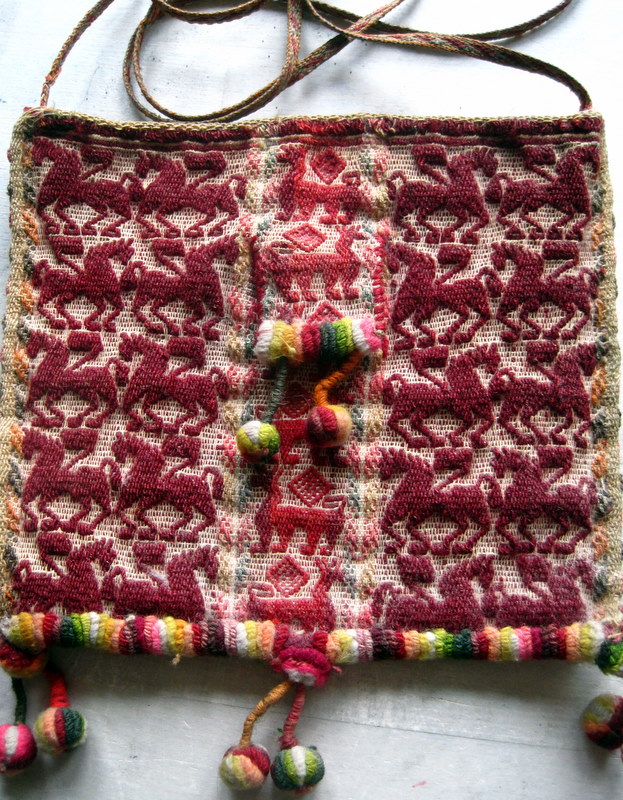
For Tarabuco we took a small truck on the Saturday, so loaded with foreigners and locals that I could see almost nothing and couldn't reach warm clothing when the sun got lower.  For the market we spent more time looking at weaving than inspecting the market, where there was little woven stuff on sale.  Olivier had a Tarabucan contact he had met in Argentina who took us to the house of a mestizo woman, where there was a more expensive collection and I bought a chuspa, decorated with horses and llamas.  A chuspa is a bag used for holding coca leaves and most of the men in the market were wearing them that day.  The market was more colourful in the afternoon, fewer gringos, more Indians.  The streets were all full of costume, like Guatemala. Particularly striking were the women's skirts, either brown with red and white designs, or black with white.  There was a wide variety of hats and some good ponchos and mantas.  As the afternoon progressed more and more aguardiente was being drunk from all sorts of tin cans and I noticed girls playing the charango.  The women were drinking as well as the men and by night-time many were laid out on the ground.

The next morning we went out into the country, through eroded sandstone and past red rocks.  After a river crossing we got away from the road and found a little plateau where it was peaceful.  As we went along I stopped from time to time to take notes:
Tarabuco Countryside 2005:  Picture by Adam Jones, CC
Greener hills on either side, stony and not very high, a vulture circling over me.  Fields of grain, barley or some sort of wheat, all over the plateau.  Stone walls and deep sunken water-courses and a few adobe houses.  There must be a village along the road as Indians keep walking past, perhaps past where there's a gap in the hills.  At first most men were coming back led by their women after the night on the town, and some of them were loaded semi-conscious on mules, now many are going in the other direction too, sober.  They wear the classic Tarabucan clothes; the men the soldier's helmet, the green/black shirt/blouse, the homespun trousers to the knee, the thick soled sandals with little straps.  A manta tied round the neck carrying the poncho and one or two other things.  A herd of donkeys, cows and pigs, tended by a woman and a girl, spinning.  Three people sitting in a cornfield by a house.  Two women passing, talking, one wears a red skirt, the other black, one of the men by the house is whistling.  The barking dog is quiet.  Two saddled donkeys on the rocky side.  You hear the silence now with these little noises.  Sparrows in the wind and the sound of charangos.  Little shrubs with red pointed leaves by the rocky track, yellow flowers by a wall. A woman with a garlanded cross in her manta.
I still have my Tarabuco chuspa hanging in my study - see picture above.  There are pictures of a more recent Tarabuco market here, and an article about Tarabuco weaving here.   And there is a picture of a Tarabuco man with donkeys here


Thursday, 21 April 2011

April 21st: Potosi

On March 21st 1976 I was in Potosi in the highlands of Bolivia.  Potosi is the site of the silver mine, the Cerro Rico, which provided the financial muscle for the Spanish colonies in South America.  Local people still work as miners there in desperate conditions.  A miner, I learned, was paid 22 to 24 pesos a day when I was there in 1976, a little over US$1.

Potosi is a high, cold city, over 4000 metres up.  The colonial buildings in the centre soon give way to the rough streets of brightly painted adobe houses which was where the poorer people lived.  Later in the day I found I needed to keep walking with the paseo in the centre or in these higher areas to keep warm. In the middle of the day it was sometimes warm enough to sit and observe what was happening in the middle of town.
Sitting in my favourite spot in Potosi, the Plaza Isabel la Catolica by the country part of the market, backed by a church in Byzantine style.  Some sellers of fruit and vegetables, selling them sitting on the ground out of the big woven bags or from canastas or direct from trucks in the road.  A queue of people buying kerosene, wooden stalls with tin roofs, many empty, some selling strange block sweets and condiments.  A row of furniture stalls at the back, tables and chairs and cabinets, doing no business.  Lettuce and onions and carrots and potatoes, little pears and grapes.

I think there are two groups of country people here.  One wear trapezoidal hats, the women in dark grey, black skirts, sometimes with embroidery at the edge and black mantas with fine pins.  Others wear triangular hats in light brown and similar black skirts but the mantas are brown weavings.  The women often wear thick woollen stockings and shoes, some wear sandals like the men.  Their hair plaits go into fancy black woollen tassels sometimes tied together.  A man wears rough trousers 3/4 down calf with a key pattern trim and a shirt covered by singlet tied at the front.  A felt tight hat.  A small manta tied round his waist, a coca pouch, woven, on his back, sandals.  Some women seem to have skirt and jacket in black and embroidery in one piece, fancy cuffs and collars.  I cannot see any clues to division by villages.  Some men wear ponchos, small and light coloured.  Many men and women carry brown, striped mantas.  Now I notice other male ponchos, woven, reds and browns with stripes, worn sideways and lengthwise, some woven coca pouches.  The waistcoats are sometimes velvet with silver and designs like the women's skirts.

In other stalls they sell cabbages and cauliflowers and beans and peas and chillies in many forms, bananas and oranges.  They sell chuños and oats and flour and several kinds of lentils, with sugar and pasta, some sugar-cane, also squashes and pumpkins.  Man selling pens, 2 for 10 pesos and 5 regalitos (little gifts, probably sweets), selling all he can.  Beggars with silver crosses.  Meat from unskinned animals in the market.
When I left Potosi I took a truck to Sucre to the east.  This turned out very well, as I recorded in my journal that evening:
Very fine ride in a truck.  Went pretty fast with only 5 or 6 passengers until the reasonably sized town of Betanzos where a couple of Indians persuaded the driver to go to their village.  This worked well as I saw the village and we had a better load on the truck afterwards.  The village was in a valley right up at the end, valley beautiful with steep rocky sides and well-cultivated centre.  Two or three communities, simple villages with donkeys in the pens.  Nearly all wearing costume, like old man leading donkeys or woman who came with us, Quechua-speaking.  Onion sets in terraces, peach trees and flowers.  Villagers happy, fit, well-fed.  A co-operative, harvest of wheat and so on coming in.  Leader very interested in the whole thing, spoke Castellano as well as Quechua.  It all seemed very successful.  Then we went through a plateau, all Indian, wheat mainly, some other sorts of grain.  Then into a river area with a grand descent, more barren.  Lunch of choclos (corn on the cob), corn humintas and chicha at Miralles.  Then over the Pilcomayo near a strange bridge and into the green-hilled Sucre province.  Climbed a bit, past a fine house painted red, and large barracks with a bizarre church, over a hill and into colonial, smart Sucre.  I had three white companions on the journey, all bilingual in Quechua and Castellano; a woman who was descended from English family called Reynolds; a man returning from Argentina to his small farm; a man taking wool and skins to Sucre.

Cerro Rico and Potosi (2006):  Picture by Christophe Meneboeuf, CC

Potosi in 2007:  Picture by Joachim Pietsch,  CC


View Tarija in a larger map

Saturday, 16 April 2011

April 16th: Tarija in Southern Bolivia

On April 16th 1976 I was in Tarija in Southern Bolivia.  It was Good Friday.

Tarija felt quite remote, a deep valley behind mountains.  I suppose there were buses, but I came in and left on trucks and the roads were all gravel or dirt.  Coming from Bermejo, on the Argentina border, we had begun in jungle and had a steep rise to real cold puna, with few people around, before descending after dark to the city at 6000 feet.  The truck had been friendly and quite full by the end, though many passengers didn't speak Castellano.   Leaving on Easter Monday and heading for Potosi, we climbed slowly out of the green valley up to the Cruz at Kilometre 40 and onto roads I'd been on before on the trip to Villazon.

This day was Good Friday and I was interested to see what there would be in the way of Easter festivities.  The day before in the late morning I caught a parade which included Hugo Banzer, the president, and the bishop, coming from the church and going round the square; then the parade of the townspeople began.  There had been another parade in the evening but these parades had seemed largely secular.  The Good Friday parade came about 5.30 in the evening, a Christ statue in a brown robe, Mary in black vestment and coffin, then two bands and the army, many people joining in the walk around.  It seemed pleasant and happy, informal.  Later as I was finishing eating in a street market, there was a second procession from the church on the hill, even less formal. A glass coffin lit by a car battery, hung with marigolds, and statue of Mary, many people, more ordinary people this time, some prayers and a little singing.  I sat in a cafe and the procession passed me.

On the Saturday with a friend I took a truck ride to San Lorenzo, a tiny colonial town nearby, to see if we could find more of the bags and other handicrafts I had seen in the market in Tarija.  The truck was very crowded so I could see little, but the Indian ladies were fun to watch in their flat cream or grey hats with a complicated flat grey bow.  San Lorenzo was actually very quiet and I didn't find the bags.  There was a pleasant bridge over a stream where we had lunch, then we walked through simple  rocky streets , with some attractive balconies and courtyards around the adobe.  Back in Tarija in the evening, everyone was drinking chicha, the Indian maize beer, straight from the gourd.  The town was busy until late.

Finally on Easter Sunday, I saw, from a distance, another small religious procession. By the evening the celebrations were secular again, with a big boxing match in the stadium, and a band and crowds of people in the plaza.


View Tarija in a larger map