Blanker

...

About This Blog

Memories of my travels between 1972 and 1982
Showing posts with label Tanzania. Show all posts

Sunday, 27 February 2011

February 27th: Rusumo in Southern Rwanda

On February 27th 1980 I was at Rusumo, where a river forms the border between Tanzania and Rwanda.  I had been informed I could get a Rwandan visa at the border, but no such luck.  I wrote this up there:
I'm actually in Rwanda even if they won't let me go beyond the village here.  The immigration people were quite friendly about it: their story is that the main chef d'immigration is in Kigali; normally he radios to Kigali if someone is at the border without a visa, but as he isn't here and the radio isn't here, the younger man in charge isn't prepared to lay his head on the line.  So Audrey has gone to Kigali with my passport to try to get me a visa, leaving me with a tin of corned beef.  However there's a shop selling things like biscuits and tinned mackerel, there's a cafe back on the Tanzanian side with chai and possibly other things, there's good sweet Rwanda beer for sixteen shillings for what must be a litre and a friendly Dutch couple working in Rulenge left me a loaf of Kigali sliced bread and an enormous carrot out of pity.  Besides this is a nice enough spot with the river and the waterfall and monkeys in the trees. 

We had taken a day and night bus from Mwanza to the town of Nzara, 16 kilometres short of the border, knowing we'd have to walk the rest of the way.  The bus journey was quite fun, the ferry at Busui, little settlements of rectangular huts mainly of wood and daub and with tin or thatch roofing and not much other than maize growing.  The bus was nearly always crowded to overflowing and nearly always friendly.  Towards evening the country began to change as we moved further from Lake Victoria, with larger hills and fewer people.  We stopped at Biharamulo in the dark and had beans and tea for supper and there was a long delay while one of the conductors sorted out a problem with the police.  Eventually we stopped for the night, at Rulenge I think, and I did manage some sleep, as the bus had more or less cleared its standing passengers.  In the morning  we crossed a big escarpment and then we walked across a new bridge while the bus took the ferry, which gave me a chance to stretch my legs.  We reached Nzara about nine, but there was little to keep us except a nice stone mission, so we had tea and andazi and began walking through pleasant rolling hills, with coffee and maize and bananas and little oblong houses and friendly people.  There were good views later on when the ever-threatening clouds pulled back a little.  But we were tired, so in the end we got a ride from a police Land-Rover carrying a Burundi refugee who had been kicked out of Rwanda two weeks previously, following the visit of a Burundi leader to the US.


View Rusumo in a larger map

Friday, 18 February 2011

February 18th: Seronera in Northern Tanzania

On February 18th 1980 I was at Seronera in the middle of the Serengeti National Park in Tanzania.  I travelled here with Audrey, an American woman from Utah.  I have described the journey from Arusha here

This was one small settlement in the middle of over 5000 square miles of the park; otherwise I believe there was only a second proper lodge at Lobo, and one or maybe two tented camps.  Seronera was the centre of the Research Institute, had an small airstrip and a petrol station, a drivers's hostel and a "Somali Hotel" which provided food for the workers.  There was also a tourist lodge built high up on a hill of boulders (kopje) which had the most wonderful views across the plains and the bluffs of the Seronera valley.  It was the season for wildebeest and at any moment you could see thousands of them spread across the plains with their attendant zebra, and hundreds of other animals.  In the end Audrey and I spent a week here, every night in a different place, negotiating deals with the manager of the lodge who rarely had many visitors and liked our trade in the bar.  We were able to go out for a wildlife drive with a group of British tourists, and made one or two other excursions.  Because Seronera was a village, you were able to walk in the immediate vicinity and this was one of the great attractions to staying there.

After a couple of days I started to look for rides out.  I wrote this in my notebook:
Sitting under an acacia on the northern road out, trying to get a ride to Musoma or Mwanza.  The hottest part of the day has already passed, and I am beginning to give up hope of a ride today, and will return to Audrey at the petrol station and the hope of a cheap hotel room tonight.  The crickets churr around me in the grass, the flies buzz around my face, a lark sings from a nearby dead tree, a starling chirps above, a flycatcher which has been here all day swoops on some insect in the road.  The breeze in the trees, a tapping which might be a woodpecker.  A distant generator, an occasional car going to the village.

View in the Serengeti:  My picture
Another day in Serengeti and I love it, I'd love to be able to spend a fortnight here with a car and money, for this country is so beautiful and hard of access.  Last night awake I saw the Southern Cross for the first time in Africa, then after dawn the light was so beautiful and the air and trees so full of birds.  Green grass plains turning yellow and occasional lines of flowers rather ordinary, flat topped acacia trees and thorn trees, one or two low hills all green, and the little kopjes of rocks and varied trees, home of lion and hyrax, from the top it seems you can see for fifty miles.  Earlier from under this shady acacia I watched a small herd of wildebeest with attendant zebra walk through the valley, buffalo and topi browsing even nearer; some giraffe ambling close, inspecting me and eating acacia tree tops, some impala peeking out of bushes; some Grant's gazelle playing; warthogs here and there including three I surprised on the road; crowned crane flying over; a big flock of sacred ibis; some lovely hawks and falcons.  You can go on and on and it's all beautiful.

Another day I was again out at the road junction and I saw what appeared to be a bus approaching.  I had heard rumours of a legendary bus which went once a week across from Arusha to Musoma on the eastern edge of Lake Victoria.  No-one knew when the bus came or would even admit to its real existence.  I rushed back to the lodge to get Audrey and my pack but when I got back the bus was already pulling away to the west having driven straight through.

Finally one evening in the bar Mr Kassam stepped out of the shadows like Peter Lorre and asked if he could be of any help to us.  He was an Ismaili trader from Mwanza delivering a shipment of meat, I think, to the lodges in his pickup.  I ended up sleeping in the pickup that night and the next day he drove us to the other lodge at Lobo in the hills towards the Kenyan border and Masai Mara.  For supper that night it was a bottle of Dodoma and a bottle of Sauternes.  But Mr Kassam got ill, perhaps malaria, and we had to wait for his driver to arrive.  We left with him lying on a mattress on the back of the pickup, and me perched on the wheel-arch in the sun for seven hours.  There was always plenty to look at as we passed, such as a lioness crouched watching a very large herd of topi, the country always beautiful, and different when we were going through the swampy black soil country which gradually gave way to the borders of Lake Victoria.   We passed by his simple home in the suburbs and visited the office which was ostensibly a stationery shop, though that was certainly not where the money came from.  His wife and daughter arranged for us to stay in the Indian-style Deluxe Hotel.  We did the local Sunday thing of visiting the zoo on an island in Lake Victoria, bizarre and sad after being a week at Seronera.  Sunday was the day of rest, Africans and Asians all out promenading, the Asian women wearing their jewels and best clothes, something I didn't see elsewhere in Africa.

Hyrax at Lobo, 2008:  Picture by bah69, CC

Picture by David d'O, 2009, CC


My picture
My picture


My picture


Tuesday, 15 February 2011

February 15th: Ngorongoro Crater

On February 15th 1980 I was on the rim of the Ngorongoro Crater in Northern Tanzania.  I was trying with a friend, Audrey, to get a lift on towards Serengeti.    

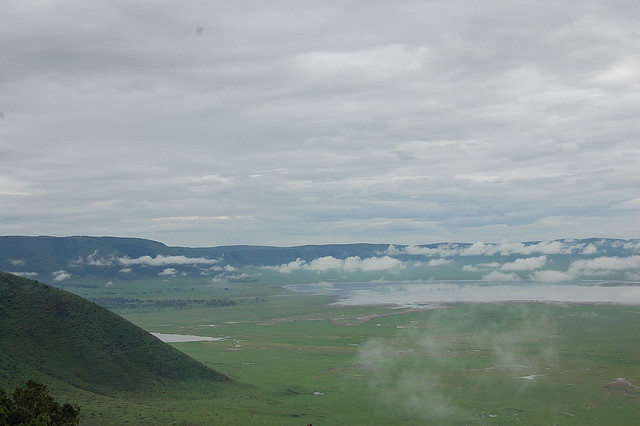
I sat much of the day at the crossroads by the Conservation Area HQ; luckily there was a Boston educated Maasai there to pass the time with along with his kinsman involved in politics who had just lost 1000 cattle to thieves.  They were trying to get to their families on the slopes of Ol Doinyo Lengai, which is an isolated volcanic mountain, effectively the sacred mountain of the Maasai.  I spent much of the time admiring the lake and the flamingos down in the crater through the binoculars, and the elephants and what else I could pick out at such a huge distance.   In the end it began to rain and when that passed we gave up.  We went back to the hotel and began the diplomacy for a ride onwards the next day.

Olduvai Gorge:  My picture
The day before we had made an expedition with a few others.  The ride to the Olduvai Gorge was beautiful and there were many new mammal or bird species; the gorge itself was somewhat atmospheric though there was no time for reflection there as elsewhere on this trip.  We had two young American students doing an archaeology module, so this was a highlight of their trip, looking round the Leakey camp and seeing the homo habilis footprints.  Then we drove down into the Ngorongoro Crater itself where the concentration of animals was fantastic even if the atmosphere was not so good as up on the hills with the Maasai.  It got fairly rainy and eventually the driver got us stuck on the little rise out of a stream, and we ran out of petrol.  Some other Land-Rovers came up half an hour or so later and that was lucky, though the drivers did keep an eye out for each other.  Soon after we saw a pride of 20 lions with little cubs, and last thing before driving up in the dying light we passed the lakeside with 5 rhino and the flock of flamingos.  In the morning at the top, the concentration of flamingos had given the lake a pink surround and I had refused to believe it could be birds, thinking it must be some sort of algae.

The trip from Arusha had already been dramatic.   I spent a day at the bus stand in Arusha but expected the bus did not leave.  The next morning we did manage to get away, passing mostly through barren country with thorn trees, occasional cultivation with little villages; one enormous field with tractor was presumably an Ujamaa village, a collective farm.  There were ostriches and bustards, and little groups of Maasai on the plain.  At Mto Wa Mbu we quickly found some lodging, and took a siesta in the heat of the day.  Later we walked to the park entrance for Lake Manyara which was most enjoyable as we passed vervet monkeys, blue monkeys and baboons in numbers, and a bushbaby which a boy pointed out to us in a tree. My mind was still in a state of wonder at seeing all these wild animals.  The next day we found Mr Lini at breakfast time and managed to persuade him to take us round the park after a bowl of Maasai blood soup (not nice) and fruit breakfast.  The park was lovely even if the trip was a bit of a whirlwind.  I'd have liked to have stayed longer at the lake, but we saw everything we expected, including lions in the trees, flamingos, hippos and a young giraffe.  In the afternoon after some lounging outside the park with the Maasai, we had a beautiful journey up to Ngorongoro with a woman and 5 children, fantastic views from the car, elephants at Manyara, fish eagles and buffaloes further on.

The diplomacy for a ride on to Serengeti worked.  We were up early for a big breakfast at the Crater Lodge, then onto the truck, five of us, including two German volunteer workers.  It was a beautiful ride, one of the rides of my life; there was hardly a place where you couldn't see hundreds of Thomson's Gazelle, and plenty of wildebeest and giraffes.  I had learned about truck rides in South America, and here I was getting the greatest ride you could ask for through the most wild and beautiful country.  At Seronera, the main settlement of the Serengeti, we found the drivers' hostel and the Somali Hotel and went for a walk.   I was up on a small rise watching a number of giraffe, and some buffalo and antelope, and enjoying the hugely varied birdlife, when there was a partial eclipse of the sun.  It got quite dark, at one point 60 and f8 on the camera pointing directly at the crescent sun.   The birds settled down and went quiet, the antelope sat down and rested their heads as if to go to sleep.  Then it got light again and the animals and birds got up and went back to their normal business.

More on my visit to Serengeti here.  

Our Maasai friend at Ngorongoro told us many stories including how he had been "The Man From Serengeti" in a National Geographic Film and had gone to University in Boston as a consequence of that.  He wrote of these stories and others in his autobiography "The Worlds of a Maasai Warrior," by Tepilit Ole Saitoti.

Words and photographs are poor tools to describe this region.  Peter Matthiesson's The Tree Where Man Was Born, in the edition with Eliot Porter's photographs, makes a good attempt.    


Ngorongoro Crater:  My picture


Ngorongoro in 2007:  Picture by Sachi Gahan, CC
Ngorongoro from the crater rim, 2006:  Picture by Dongyi Liu, CC


Tuesday, 8 February 2011

February 8th: Mount Meru in Northern Tanzania

On February 8th 1980 I was walking with a friend up the slopes of Mount Meru, the volcano which dominates the city of Arusha in northern Tanzania.

After a couple of days in Arusha I had worked out a couple of things: firstly, there wasn't much to do and there were hardly any other cheap travellers around, and secondly there was no point in even thinking about going on any organised tours to get into the wildlife parks.  So, I thought, let's just walk towards the mountain and see what happens - this was my first walk in Africa.

Getting through the suburbs in the late afternoon immediately felt better, then I reached the Nairobi - Moshi road, and there was a turning to the left at the village of Sekei and after a moment's hesitation I took it because it felt right first time.  I went up through the straggly village with bars and shops and crowds of people going home.  The country got better, up in the coffee fields, bananas, maize, cabbages.  Huts became simpler and simpler, rounder and more thatched, the women with less city clothes.  There were plenty of Maasai walking.  There was a field with church and mission bell, and a white woman in a Rover.  I gained a schoolboy companion and on the way back down we stopped at his house in the dying light for tea and looked at his photos of foreigner friends.  It was good to be among the fields with the stars above.  I was shown to the main road in the darkness, and went into a bar with others for pombe, millet beer.

The next morning I met Audrey, American and a few years older than me, and within seconds we were talking about how we could go further up towards the mountain, starting the next day.  So on this day we left at daybreak, poking around in Sekei, looking for a chai but it was still too early.  I was carrying an outsize avocado to eat for breakfast, which we took under the shade of a tree down a little lane.  We were happy and optimistic enjoying the "Jambo!"s  and "Where are you going?", but knowing we were not going to get very far up the mountain.  The next village had a wonderful large fig tree with a double trunk and hanging roots.  In the last village there were no corrugated iron roofs but all around mud and wattle huts, often with a second little one in the compound and with maize and banana fields and sometimes pastures cut for cattle.

Then we were in a spruce and pine forest, dark with a stream running through it and the first little orchids, pinkish.  We came to a clearing around a giant fallen mahogany tree where we sat for a while in the sunshine looking at the green forest trees around us and the hornbills.  As we walked on we had a fine view westwards towards a green hill that must have been beside the road north to Kenya.  Further up the ridge was steep but easy, very beautiful and jungly with more orchids, colourful birds calling in all directions, and the noise of colobus monkeys moving through trees.  At some point we crossed from the ridge to the mountain itself.  The forest was full of drum-shaped hives and the trails leading to them.  The trails were bigger where the bamboo cutters had been in; some places were quite dark, some places were swampy with by-passes; we saw a pair of colobus monkeys at one point among calabash trees and bright red flowers, the first wild animals I'd seen while walking in Africa. 

On The Edge of Mount Meru:  My picture
Finally we reached a clearing where we could see the clouds above us across a river and a steep precipice but we could not make out the top of the forest and could not find a trail.  After walking all day we had done enough and we had only food and water for the one night.  So we listened to a wood cutter on the other side of the river, and his cow, and then came down.  We found quite a large trail and, as the sunlight was fading, a nice camping spot.  We enjoyed the final rays of the sun beside a tiny blue orchid, collected firewood, ate our beans hot and our carrots and settled down to try to sleep in what was a cold night.  The stars and the moon and the hornbills rowdily roosting were fine but I was pleased when the sun got up in the morning.

The down trail was really easy, but as is usual not so interesting.  We found bamboo cutters pulling their loads down the trail.  We had frequent rests to admire scenery, the trees and the birds, to warm up, to eat mangoes, and eventually to find running water.  We cut back to where we had been the day before near the pine forest and found a closed valley for a couple of hours, lazing, watching black and white colobus monkeys in the jungle on the escarpment, there were maybe 15 or 20 of them, nearly always in view.  We saw groups of boys with cattle.  The way back was wearisome, but we were well greeted by Maasai and others as we sat under the double fig tree.  Eventually we were taken to the pombe shop for much needed refreshment.

Mount Meru:  My picture

Wednesday, 2 February 2011

February 2nd: Dar Es Salaam

On February 2nd 1980 I was in Dar Es Salaam.  I arrived in the afternoon after an overnight flight from London.  My previous effort to get to Africa had died in Morocco in 1977.  My idea this time was to spend three months or so in East Africa, starting in Tanzania and ending up in Nairobi and seeing what I could in between.   The border between Kenya and Tanzania was firmly closed when I left, Zaire was a possibility depending on finding a visa and Uganda seemed to be open again after the overthrow of Idi Amin by the Tanzanian army nine months previously.

The flight to Addis Ababa was fine, filling up after Rome.  I'd been drinking champagne with friends in London and drank brandy with a friendly Italian businessman which helped me sleep.  When it got light we were still over the desert, but then we flew over Lake Tana, blue and muddy below, with the Nile Falls visible.  Ethiopia looked beautiful as it got greener, more rectangular fields and circular compounds and hayricks and huts.  At the stopover in Addis, the air was clear and warm and invigorating after London in early February.  Inside I sat briefly at the bar with a Swiss man working in Washington with the World Bank on  a two day visit.  He talked of fear and suspicion among the people, but he had a hatred of communism and all things red.  Our flight was delayed and I and everyone else seemed increasingly nervous; it was a most unfriendly couple of hours.  I gathered later that there had been hijacking incidents recently.  Kenya seemed more developed from the air, roads or straight tracks everywhere; one large pond or small lake had some animals visible.  Mount Kenya was clouded over and there was a storm over Zanzibar and the blue coral sea as we came down to land from over the ocean.  Most of the other tourists got swept into their rich hotels and I got a booking for the Hotel Mboye from the information clerk, very friendly but after my black market money.  I took the airport bus with a couple of my age American missionaries from Nairobi, who were convinced that the bus was going a long way round just to "shuck" them.  At the Mboye there was a room with a fan and a manager who brought me beer and hassled me to change money.

The next day I walked around, liking the African town around the Kariakoo market rather than the Indian town which took up much of the centre.  The day after, with my bus ticket to Arusha bought, I hung about near the ocean front, liking the sea breeze, the gulls and Nyerere's peacocks.

The bus journey was all night through heavy rain at first when the traffic got jammed, and then the road got worse when we started to climb.  I woke up to the sight of ostriches on the plain and ahead of us was Mount Kilimanjaro.  I transferred to a local bus with some of my money given back, as myself and a Swiss nurse were the only passengers travelling on to Arusha.  The new bus was full of farmers and some Maasai.  The countryside seemed beautiful especially the mountains and the coffee estates with rivers in between, and Maasai groups with their fine cattle and donkeys.  


View Dar in a larger map